AI Chatbot for Tenant Screening Companies
Narasimhan Vallur | 2026-11-10
Last updated: November 10, 2026
An AI chatbot for tenant screening companies helps website visitors understand the service, ask product questions and take the next step toward a sales conversation. LOFTx.ai supports this customer-engagement use case through website chat, company-specific answers, a customizable voice and business lead capture.
For companies selling AI-based screening, income verification or fraud-detection software, the website is where a property manager starts evaluating the business. The visitor may be ready to discuss a portfolio, or may need a few questions answered before requesting a demo. A useful chatbot serves both moments.
Rent Butter and Docuverus show how the experience can reflect different brands. Rent Butter has customized its Loftx chatbot to speak in its own voice. Docuverus has kept its assistant highly professional. The same platform supports both approaches.
What an AI chatbot for tenant screening companies should do
A screening provider's website attracts people with different needs. A property manager may be comparing vendors. An existing customer may need help. A rental applicant may be looking for a support destination.
The chatbot's first job is to understand the inquiry and make the next step clear. For a business prospect, a useful journey is:
- Answer the product question. Use the company's approved explanations and knowledge base.
- Understand the business need. Establish what the visitor wants to discuss with the team.
- Capture relevant contact details. Give sales enough context to follow up usefully.
- Offer the next step. Direct the visitor to the configured demo or contact action.
- Bring in a person when needed. Keep a human handoff available for questions that need judgment or a detailed discussion.
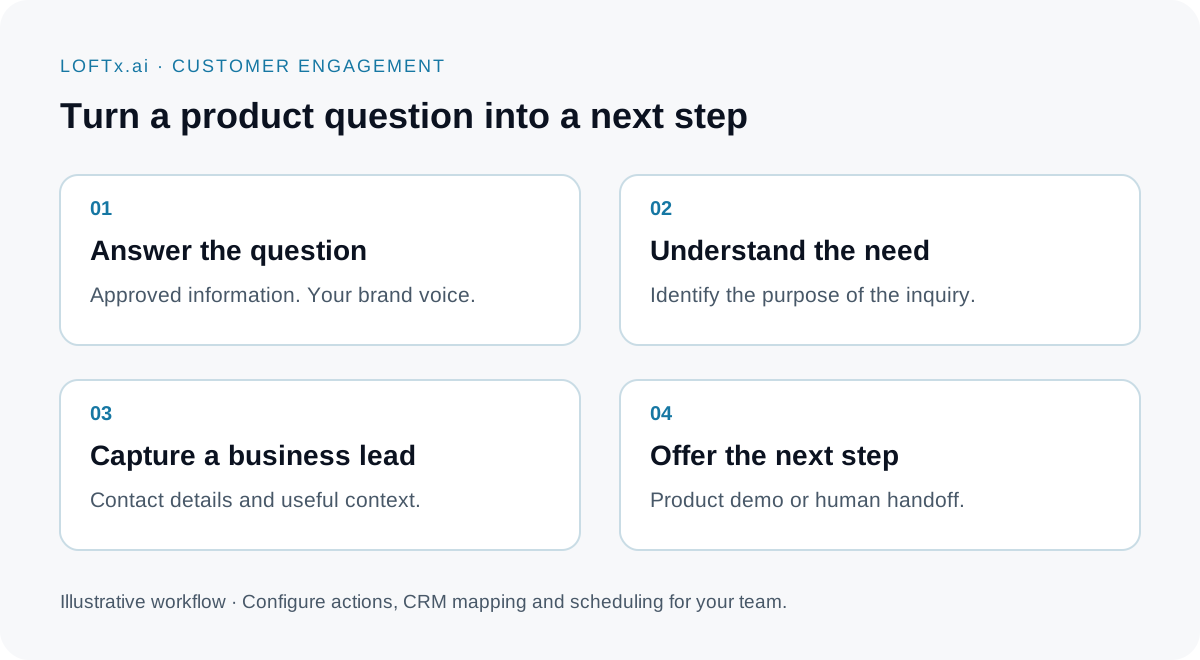
A suggested business-inquiry journey. Configure the actions and destinations for your team.
LOFTx.ai's role here is customer engagement and sales intake. Tenant screening and application decisions stay in the screening provider's own workflow.
Rent Butter: a chatbot that speaks in its own voice
Rent Butter provides tenant screening and verification tools for property managers. It has customized its LOFTx.ai chatbot to speak in the company's own voice, carrying its identity from the website into the conversation.
That is an important choice for a business investing in its brand. The assistant's greeting, explanations and invitations should feel connected to the company a visitor came to learn about.
For another screening provider, the practical starting point is approved website copy and examples of how the team communicates. Use those to define the assistant's tone, then review how it answers questions, asks for contact information and offers a next step.
Read the dedicated Rent Butter chatbot brand-voice use case for more on that approach.
Docuverus: a professional customer conversation
Docuverus focuses on income verification and rental fraud detection. It has kept its LOFTx.ai chatbot highly professional, choosing a style that fits how it wants to engage website visitors.
A professional assistant can be direct and approachable: explain the service clearly, ask relevant questions and make it easy to reach the team. Personality customization includes choosing this restrained style.
Docuverus's public website also distinguishes prospective business customers from applicants seeking support. That is a useful design principle for screening-company websites: make the route fit the visitor's purpose, rather than sending every inquiry into the same sales process.
Explore the Docuverus professional website-chatbot use case for the communication and routing considerations.
Turn website questions into useful business leads
Lead capture should preserve why someone reached out. A name and email become more useful when the sales team also knows what the visitor wants to discuss.
For example, a property manager might ask:
We manage 800 units and are reviewing our screening process. Can someone walk us through your service?
Illustrative business inquiry, not a customer transcript.
For a conversation like this, a team could configure its intake around the visitor's name, work email, company, portfolio size and product interest. Those are suggested fields; the right set depends on the sales process.
LOFTx.ai's website chat captures visitor details and questions for the team and supports live takeover. The goal is a useful continuation of the conversation: the representative understands the inquiry, and the visitor knows who will help next.
Connect the journey to HubSpot or Salesforce
LOFTx.ai lists HubSpot CRM and Salesforce among its integrations. For a tenant-screening business, CRM setup should follow the way its sales team already manages inquiries.
During implementation, define:
- which contact and business details the chat should collect;
- which CRM records and fields the integration supports for that setup;
- how the team receives the inquiry and its context;
- who owns the follow-up;
- how duplicate contacts and unsuccessful transfers will be handled.
Confirm the supported mapping and workflow before launch. The customer examples above demonstrate brand customization; they do not establish which CRM Rent Butter or Docuverus uses with Loftx.
Move from interest to a product demo
Both companies' public websites invite visitors to discuss their products. For this business-to-business use case, the relevant booking is a product demo or walkthrough with a sales team.
Give an interested visitor a clear invitation and a configured next step. That may be an approved scheduling link or a booking workflow confirmed during setup. Make the distinction clear to the visitor: requesting a meeting and receiving a confirmed appointment are different outcomes.
An effective demo invitation explains the purpose of the meeting. If the visitor asked about a portfolio's screening needs, carry that topic into the handoff so the team can prepare.
Measure the quality of the conversations
To evaluate a rollout, track business inquiries separately from applicant-support questions. Useful measures include:
- inquiries with usable contact details and a clear business need;
- questions resolved from approved information;
- conversations handed to the right team;
- demos requested, booked and attended;
- opportunities accepted by sales.
These are recommended measures, not reported results for Rent Butter or Docuverus. Use your own baseline and reporting period to judge whether the chatbot is helping visitors and the sales team.
Put your screening company's website to work
Your next customer may arrive with one question before they are ready to book a demo. Give them a helpful answer, an experience that sounds like your company and a clear way forward.
Book a demo to explore LOFTx.ai for your tenant-screening website. Bring your preferred brand voice, common product questions, CRM and scheduling process so we can walk through the right customer-engagement setup for your business.